INTRODUCTION BY SIMON BROOK
The Mahabharata holds a genuinely unique place both in my father Peter Brook’s filmography and in the great History of Cinema. But could it be any different when tackling “The Mahabharata”? A book that lies at the very foundation of Indian mythology, religion, history and thinking, a book fifteen times longer than the Bible alone!
This monumental work explores the entanglements between war, ethics and power. More than a mere tale, it is an epic that transcends time and space, and exposes the dilemmas and devastating consequences resulting from man’s choices. Spanning several generations, this story chronicles the descent into hell of two branches of the same family, caught up in an extreme fratricidal conflict that sows death and destruction on a massive scale.
The Mahabharata also holds a special place in my memories and in my heart. As a teenager, I had the privilege to travel with my father and Jean-Claude Carrière, his co-writer, on their first few research trips to India as the “official photographer”. I witnessed their creative process as they were worked on their future play. Although these trips proved fascinating for all of us, the recurring question remained unanswered for a long time: “How to reduce the longest book in the world to a length suitable for the stage?”
The play ended up being a nine-hour theatrical event and audiences were given the choice of seeing the play in its entirety or returning over three consecutive evenings to attend a three-hour performance. The Mahabharata was a phenomenal success. It toured for over two years, on three continents, in fourteen cities, all to sold-out houses. It was a major artistic shock that would leave a lasting impression on a generation of theatre goers.
While the length of the show was unusual, the cast was no less so. In keeping with my father’s multicultural approach the actors came from all around the world: Africa, Japan, Indonesia, France, Greece, Cambodia, Poland... Over 16 different nationalities in all!
My father nurtured the dream of bringing this epic to the screen and wanted to make a six-hour movie. This was deemed to be lunacy and unfinanceable, so the decision was taken to shoot concurrently a three-hour film version and a six-hour TV version.
The Mahabharata is a theatrical film that asserts itself from the very first shot, leading the viewer into another world, one of suggestion rather than mere exposition and demonstration. The freedom of form gives the film a remarkable uniqueness, being an Indian tale, filmed in English, shot in a studio in the suburbs of Paris, with international actors and crew, and truly reflects Peter Brook’s vision of universality.
Acclaimed upon its release, the film was hailed for its cultural and artistic significance. It was greeted by a 20-minute standing ovation when it premiered at the Venice Film Festival in 1989, and the TV version was awarded the Prix Italia and an Emmy Award in 1990. And today more than ever, the film retains a powerful immediate impact and universal relevance.
Despite what was then considered an unusual length at just under three hours, the film met with enthusiastic response worldwide and was hailed for its cultural and artistic significance. The Mahabharata remains an emblematic work of contemporary cinema, an essential part of international cinema heritage, transcending cultural, social and artistic barriers. Its restoration and rebirth are part of “The Mahabharata”’s message of hope and raise a mirror to the complex challenges of our time.
As happens so often, the laboratory went bankrupt, the producer was busy with other films and all the 35MM prints of The Mahabharata vanished. There was only an old TV transfer.
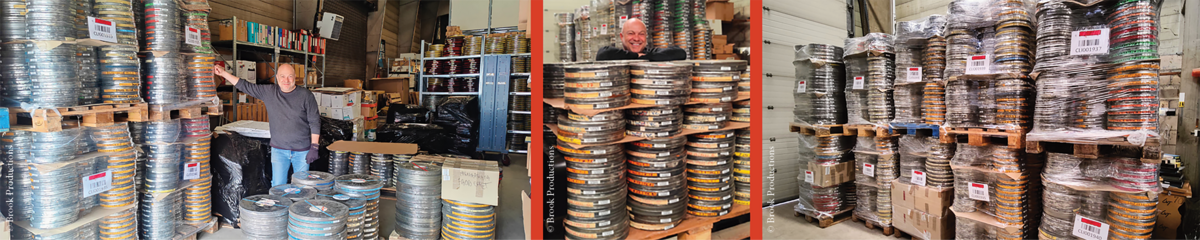
This made my father very sad. He was very proud of his film and felt that it could have real importance for today’s audiences. So, I decided to take on the mission impossible of regaining control of the 3451 reels of negative and sound so that it could be restored to its original glory.
Under my close supervision the film was restored by the fantastic and passionate team at TransPerfect Media (France) and thanks to support of the French National Centre of Cinema (CNC). The original camera negative was scanned in partnership with Prasad Corporation in Germany, using the DFT Polar HQ scanner, with a state-of-the-art 9.3K monochrome field array sensor, resulting in ultra-high resolution native 8K with 16-bit RGB color depth. The Mahabharata is one of the very first 35MM Heritage films to be restored using this process and it seemed to us to be particularly appropriate to apply advanced technology to a film so rich, vibrant, and filled with subtle emotions.
The restored version The Mahabharata premiered in September 2024 at the Venice Film Festival in Official Competition.